
Learn Digital Marketing for Beginners
Digital marketing for beginners can seem overwhelming when you are just starting. You may come across terms such as SEO, content marketing, social media marketing, Google Ads, email marketing, analytics, and conversion optimization—all at the same time.
The good news is that you do not need to master everything immediately.
Instead, the better approach is to understand how the major channels
work together, learn one skill at a time, and practise what you learn
through real projects.
This guide explains beginner digital marketing guide in a practical way and provides a simple roadmap you can follow whether
you are a student, aspiring freelancer, business owner, or someone
looking to build a career in marketing.
What Is Digital Marketing?

Digital marketing is the promotion of products, services, brands, or
ideas through digital channels.
These channels can include:
- Search engines
- Websites and blogs
- Social media platforms
- Online advertising
- Video platforms
- Mobile and other digital channels
Unlike traditional marketing, digital marketing gives businesses many
ways to reach specific audiences and measure actions such as website
visits, leads, engagement, and sales.
However, digital marketing is not simply about posting on social media
or running advertisements. Effective marketing starts with understanding
the audience, identifying a problem or need, creating useful
communication, selecting appropriate channels, and measuring the
results.
Why Should You Learn Digital Marketing?
Today, businesses need ways to attract customers, communicate with their
audiences, and generate measurable results online. As a result, this has
created opportunities for employees, freelancers, entrepreneurs, and
creators.
For beginners, another advantage is that you can practise many digital
marketing skills without working for a large company.
For example, you can create your own website and use it as a learning
project. You can publish articles, practise SEO, experiment with social
media content, study analytics, and gradually build a portfolio.
More importantly, the key is to move beyond simply consuming tutorials.
Learning becomes much more valuable when you apply it.
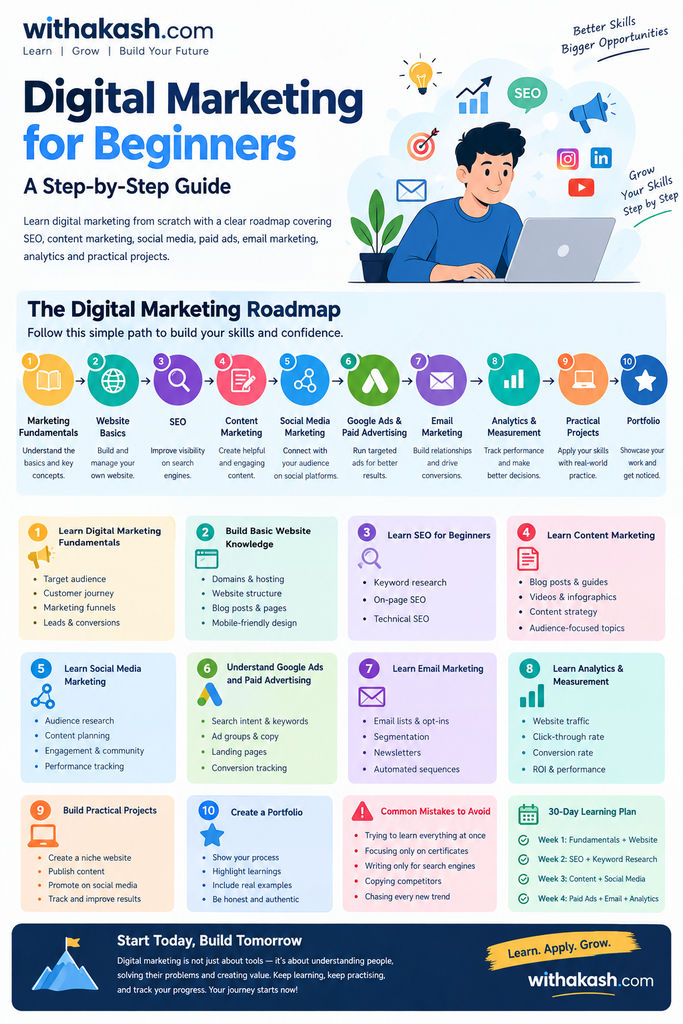
Digital Marketing Roadmap for Beginners

If you are
wondering how to learn digital marketing,
start with the fundamentals. Then, avoid trying to learn every channel
simultaneously.
A practical roadmap can look like this:
Marketing fundamentals → Website basics → SEO → Content marketing →
Social media → Paid advertising → Email marketing → Analytics →
Practical projects → Portfolio
You can adjust this order depending on your career goal. However,
understanding the fundamentals first makes the individual channels
easier to understand.
Let’s look at each stage.
1. Learn Digital Marketing Fundamentals
Before opening an SEO tool or creating an advertisement, understand
basic marketing concepts.
Start with:
- Target audience
- Customer journey
- Buyer personas
- Marketing funnels
- Leads and conversions
- Brand awareness
- Customer acquisition
- Organic and paid marketing
- Return on investment
Together, these concepts help you understand why a marketing activity
is being performed.
For example, getting 10,000 website visitors may sound impressive, but
traffic alone does not necessarily mean a campaign was successful. The
business may care more about qualified leads, sales, registrations, or
another meaningful outcome.
Learning to connect marketing activity with business objectives is one
of the most important skills you can develop.
2. Build Basic Website Knowledge
For beginners, a website is useful as a practical environment for
learning digital marketing.
You do not need to become a professional developer. Instead, learn the
basics of:
- Domains and hosting
- Website structure
- Web pages and blog posts
- Navigation
- URLs
- Images and alt text
- Page titles and descriptions
- Basic website performance
- Mobile-friendly design
In addition, creating your own small website gives you something to
experiment with.
You can publish articles, improve their structure, monitor search
performance, and use the results to understand how different marketing
activities affect your website.
3. Learn SEO for Beginners
Search engine optimization, or SEO, focuses on improving a website’s
visibility in search engines and helping searchers find useful content.
However, SEO is much broader than inserting keywords into an article.
Important areas include:
Keyword research
Keyword research helps you understand what your audience searches for.
For example, instead of targeting only the broad term “digital marketing,” a beginner-focused website might create content around
searches such as:
- How to learn digital marketing
- Digital marketing roadmap for beginners
- SEO for beginners
- Digital marketing skills to learn
- Digital marketing portfolio ideas
Therefore, the goal should not be to repeat these phrases as many times
as possible. Instead, your content should naturally answer the question
behind the search.
On-page SEO
On-page SEO includes elements such as:
- Helpful and relevant content
- Clear headings
- Descriptive titles
- Logical internal links
- Easy-to-read formatting
- Relevant images
- Descriptive URLs
Technical SEO
Technical SEO deals with how effectively search engines can access and
understand your website.
Beginners should gradually learn about:
- Crawling and indexing
- XML sitemaps
- Robots.txt
- Canonical URLs
- Mobile usability
- Page experience
- Structured data
You do not need to become an expert in every technical topic before
publishing your first article.
For this reason, start with the fundamentals and improve as your website
grows.
4. Learn Content Marketing

Content marketing is about creating useful content for a defined
audience.
Your content could include:
- Blog posts
- Videos
- Guides
- Case studies
- Social media posts
- Newsletters
- Infographics
Instead, a good content strategy begins with audience problems rather
than a random list of keywords.
Suppose your audience consists of students learning marketing. Instead
of publishing ten nearly identical articles targeting slightly different
keywords, you could create a useful learning hub containing:
- Digital marketing fundamentals
- SEO for beginners
- Keyword research
- Content marketing
- Social media marketing
- Google Ads
- Analytics
- Portfolio building
As a result, each article can answer a different question while linking
naturally to related resources.
5. Learn Social Media Marketing

Social media marketing involves using platforms such as Instagram, Facebook, LinkedIn, YouTube,
or other relevant networks to communicate with an audience.
Start by learning:
- Audience research
- Content planning
- Platform-specific content
- Copywriting
- Visual content
- Engagement
- Community management
- Performance measurement
However, do not assume that publishing more posts automatically produces
better results.
Instead, identify the audience, understand what they care about, create
useful content, and measure what happens.
For example, you can practise by creating a niche social media page or
managing social content for a small project.
6. Understand Google Ads and Paid Advertising
Although organic marketing can take time, paid advertising allows
businesses to pay for exposure on advertising platforms.
For beginners, Google Ads is an important area to understand.
Start with concepts such as:
- Search intent
- Keywords
- Ad groups
- Ad copy
- Landing pages
- Bidding
- Conversion tracking
- Cost per click
- Conversion rate
At first, do not start by spending a large amount of money.
First learn how campaigns are structured and understand the metrics.
When you eventually run campaigns, use a controlled budget and measure
the results carefully.
7. Learn Email Marketing

Email marketing remains useful because it gives businesses a direct communication
channel with people who have chosen to hear from them.
A beginner should understand:
- Email lists
- Opt-in forms
- Segmentation
- Subject lines
- Newsletters
- Automated sequences
- Calls to action
- Open and click performance
- Conversions
For example, a marketing blog could offer a useful checklist in exchange
for an email subscription and then send subscribers educational content.
Most importantly, the objective should be to provide value rather than
sending promotional messages constantly.
8. Learn Analytics and Measurement
Notably, one of the biggest differences between digital marketing and
traditional marketing is the amount of measurable data available.
You should gradually learn how to interpret metrics such as:
- Website traffic
- Engagement
- Click-through rate
- Conversion rate
- Leads
- Cost per acquisition
- Revenue
- Return on advertising spend
Therefore, do not focus on individual numbers without context.
For example, an increase in traffic is useful information, but you
should also investigate where that traffic came from, whether visitors
were relevant to the business, and whether they completed the desired
action.
Ultimately, the ability to turn data into decisions is an important
digital marketing skill.
9. Build Practical Projects
This is where your learning becomes experience.
For example, you could create a small website about a topic you
understand and then:
- Research relevant topics.
- Create a content plan.
- Publish useful articles.
- Apply basic SEO.
- Promote your content.
- Monitor performance.
- Improve older articles.
- Document what you learned.
In addition, a social media project can help you practise your skills.
You could analyse an existing business website, prepare a sample Google
Ads campaign, or build an email marketing sequence.
Moreover, there is no need to wait for your first job before building
a portfolio.
Your own projects can demonstrate how you think and what you can
actually do.
10. Create a Digital Marketing Portfolio
In practice, a portfolio is more useful when it shows evidence of your
process rather than simply listing skills.
For each project, explain:
- What was the objective?
- Who was the target audience?
- What strategy did you use?
- What work did you complete?
- Which tools did you use?
- What happened?
- What did you learn?
- What would you improve?
If you are a beginner and do not have impressive numerical results yet,
be honest about that.
A well-documented learning project can still demonstrate initiative,
research ability, problem-solving, and practical knowledge.
Common Digital Marketing Mistakes Beginners Should Avoid
Trying to learn everything at once
SEO, paid advertising, content, social media, email, analytics, and
automation are all large subjects.
Choose one area to practise first and expand your skills gradually.
Focusing only on certificates
Courses and certifications can help structure your learning, but
completing a course does not automatically mean you can execute a
campaign successfully.
Therefore, combine learning with projects.
Writing only for search engines
Above all, your article should be useful to people first.
Avoid forcing a keyword into every paragraph, heading, or sentence.
Google specifically describes unnatural repetition of keywords as
keyword stuffing.
Copying competitors
Competitor research can help you identify topics and gaps, but simply
rewriting existing articles does not create a strong reason for users to
choose your content.
Instead, add your own examples, explanations, research, experience, or
practical framework.
Chasing every new marketing trend
Although digital marketing changes frequently, its fundamentals remain
important.
Therefore, build a strong foundation in audience research, content, SEO,
advertising, analytics, and communication before jumping from one new
tool to another.
A Simple 30-Day Learning Plan
If you are completely new, you can start with this structure:
During the first week, focus on marketing fundamentals and website
basics.
In the second week, study SEO fundamentals, keyword research, and
on-page optimization.
By the third week, learn content marketing and social media
marketing. For example, create your first pieces of content.
Finally, during the fourth week, study basic paid advertising, email
marketing, and analytics. In addition, document your project and begin
building a portfolio.
Overall, the exact timeline is flexible. The important part is
consistency and practical application.
Final Thoughts
Fortunately, learning digital marketing does not require you to
understand every tool or platform from day one.
Instead, start with the fundamentals, choose a practical learning path,
and build something while you learn.
A strong beginner roadmap can be as simple as:
Understand marketing → Build a website → Learn SEO → Create content →
Practise social media → Understand paid ads → Learn email → Measure
results → Build projects → Create a portfolio.
Most importantly, do not confuse consuming information with developing a
skill.
In other words, read, practise, measure, make mistakes, improve, and
document your progress.
That process will give you a much stronger foundation for a career in
digital marketing than simply collecting a long list of tools and
certificates.