Author name: Akash Verma

Digital marketing for beginners
Digital Marketing, SEO

Digital Marketing for Beginners: A Step-by-Step Guide

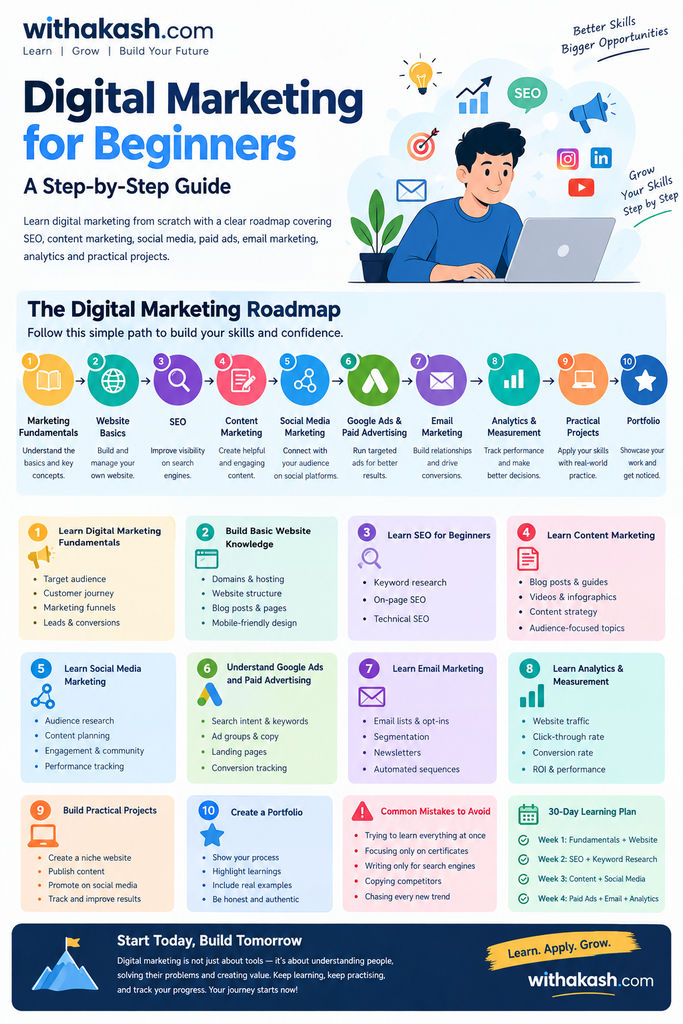
Learn Digital Marketing for Beginners Digital marketing for beginners can seem overwhelming when you are just starting. You may come across terms such as SEO, content marketing, social media marketing, Google Ads, email marketing, analytics, and conversion optimization—all at the same time. The good news is that you do not need to master everything immediately. Instead, the better approach is to understand how the major channelswork together, learn one skill at a time, and practise what you learnthrough real projects. This guide explains beginner digital marketing guide in a practical way and provides a simple roadmap you can follow whetheryou are a student, aspiring freelancer, business owner, or someonelooking to build a career in marketing. What Is Digital Marketing? Digital marketing is the promotion of products, services, brands, orideas through digital channels. These channels can include: Unlike traditional marketing, digital marketing gives businesses manyways to reach specific audiences and measure actions such as websitevisits, leads, engagement, and sales. However, digital marketing is not simply about posting on social mediaor running advertisements. Effective marketing starts with understandingthe audience, identifying a problem or need, creating usefulcommunication, selecting appropriate channels, and measuring theresults. Why Should You Learn Digital Marketing? Today, businesses need ways to attract customers, communicate with theiraudiences, and generate measurable results online. As a result, this hascreated opportunities for employees, freelancers, entrepreneurs, andcreators. For beginners, another advantage is that you can practise many digitalmarketing skills without working for a large company. For example, you can create your own website and use it as a learningproject. You can publish articles, practise SEO, experiment with socialmedia content, study analytics, and gradually build a portfolio. More importantly, the key is to move beyond simply consuming tutorials. Learning becomes much more valuable when you apply it. Digital Marketing Roadmap for Beginners If you arewondering how to learn digital marketing,start with the fundamentals. Then, avoid trying to learn every channelsimultaneously. A practical roadmap can look like this: Marketing fundamentals → Website basics → SEO → Content marketing →Social media → Paid advertising → Email marketing → Analytics →Practical projects → Portfolio You can adjust this order depending on your career goal. However,understanding the fundamentals first makes the individual channelseasier to understand. Let’s look at each stage. 1. Learn Digital Marketing Fundamentals Before opening an SEO tool or creating an advertisement, understandbasic marketing concepts. Start with: Together, these concepts help you understand why a marketing activityis being performed. For example, getting 10,000 website visitors may sound impressive, buttraffic alone does not necessarily mean a campaign was successful. Thebusiness may care more about qualified leads, sales, registrations, oranother meaningful outcome. Learning to connect marketing activity with business objectives is oneof the most important skills you can develop. 2. Build Basic Website Knowledge For beginners, a website is useful as a practical environment forlearning digital marketing. You do not need to become a professional developer. Instead, learn thebasics of: In addition, creating your own small website gives you something toexperiment with. You can publish articles, improve their structure, monitor searchperformance, and use the results to understand how different marketingactivities affect your website. 3. Learn SEO for Beginners Search engine optimization, or SEO, focuses on improving a website’svisibility in search engines and helping searchers find useful content. However, SEO is much broader than inserting keywords into an article. Important areas include: Keyword research Keyword research helps you understand what your audience searches for. For example, instead of targeting only the broad term “digital marketing,” a beginner-focused website might create content aroundsearches such as: Therefore, the goal should not be to repeat these phrases as many timesas possible. Instead, your content should naturally answer the questionbehind the search. On-page SEO On-page SEO includes elements such as: Technical SEO Technical SEO deals with how effectively search engines can access andunderstand your website. Beginners should gradually learn about: You do not need to become an expert in every technical topic beforepublishing your first article. For this reason, start with the fundamentals and improve as your websitegrows. 4. Learn Content Marketing Content marketing is about creating useful content for a definedaudience. Your content could include: Instead, a good content strategy begins with audience problems ratherthan a random list of keywords. Suppose your audience consists of students learning marketing. Insteadof publishing ten nearly identical articles targeting slightly differentkeywords, you could create a useful learning hub containing: As a result, each article can answer a different question while linkingnaturally to related resources. 5. Learn Social Media Marketing Social media marketing involves using platforms such as Instagram, Facebook, LinkedIn, YouTube,or other relevant networks to communicate with an audience. Start by learning: However, do not assume that publishing more posts automatically producesbetter results. Instead, identify the audience, understand what they care about, createuseful content, and measure what happens. For example, you can practise by creating a niche social media page ormanaging social content for a small project. 6. Understand Google Ads and Paid Advertising Although organic marketing can take time, paid advertising allowsbusinesses to pay for exposure on advertising platforms. For beginners, Google Ads is an important area to understand. Start with concepts such as: At first, do not start by spending a large amount of money. First learn how campaigns are structured and understand the metrics.When you eventually run campaigns, use a controlled budget and measurethe results carefully. 7. Learn Email Marketing Email marketing remains useful because it gives businesses a direct communicationchannel with people who have chosen to hear from them. A beginner should understand: For example, a marketing blog could offer a useful checklist in exchangefor an email subscription and then send subscribers educational content. Most importantly, the objective should be to provide value rather thansending promotional messages constantly. 8. Learn Analytics and Measurement Notably, one of the biggest differences between digital marketing andtraditional marketing is the amount of measurable data available. You should gradually learn how to interpret metrics such as: Therefore, do not focus on individual numbers without context. For example, an increase in traffic is useful information, but youshould also investigate
Digital Marketing, SEO

Guide to Growing Your Business Online

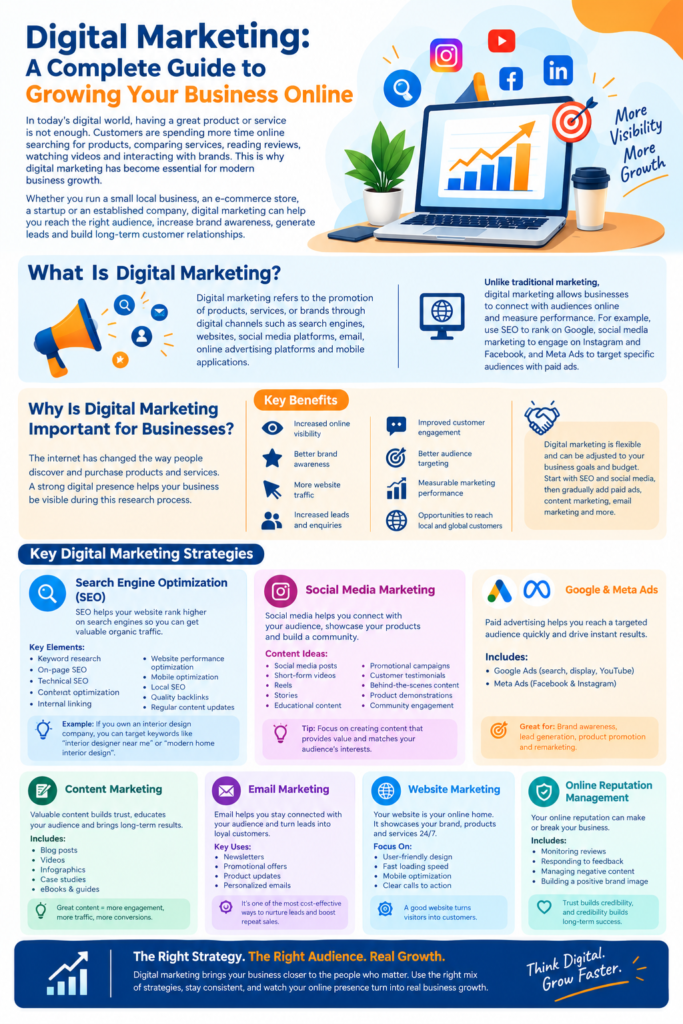
Guide to Growing Your Business Online is a practical resource for businesses that want to build a strong online presence, attract more customers, and achieve sustainable growth through digital marketing Why Is Digital Marketing Important for Businesses? In today’s digital world, having a great product or service is not enough to grow a business. Customers are spending more time online searching for products, comparing services, reading reviews, watching videos, and interacting with brands. This is why digital marketing has become an essential part of modern business growth. Whether you run a small local business, an e-commerce store, a startup, or an established company, digital marketing can help you reach the right audience, increase brand awareness, generate leads, and build long-term customer relationships. Digital marketing includes several online marketing techniques such as SEO, social media marketing, Google Ads, Meta Ads, content marketing, email marketing, website marketing, and online reputation management. When these strategies work together, businesses can create a strong online presence and reach potential customers at different stages of their buying journey. What Is Digital Marketing? Digital marketing refers to the promotion of products, services, or brands through digital channels such as search engines, websites, social media platforms, email, online advertising platforms, and mobile applications. Unlike traditional marketing methods such as newspapers, television, radio, and printed advertisements, digital marketing allows businesses to connect with audiences online and measure many aspects of their marketing performance. For example, a business can use search engine optimization (SEO) to appear in Google search results, social media marketing to engage customers on Instagram and Facebook, and Meta Ads to target specific audiences with paid advertisements. The main objective of digital marketing is to put your business in front of potential customers when they are looking for information, products, or services related to your business. Why Is Digital Marketing Important for Businesses? The internet has changed the way people discover and purchase products and services. Before visiting a store or contacting a company, many customers first search online. A strong digital presence can help your business become visible during this research process. Some important benefits of digital marketing include: Digital marketing can also be flexible according to your business goals and budget. A company can start with SEO and social media marketing and gradually introduce paid advertising, content marketing, email marketing, and other strategies. Search Engine Optimization (SEO) Search Engine Optimization, commonly known as SEO, is one of the most important parts of digital marketing. SEO involves optimizing a website and its content so that search engines can better understand the website and potentially display its pages in relevant search results. When someone searches for a product or service, appearing prominently in search results can help bring valuable organic traffic to your website. An effective SEO strategy generally includes: For example, if you own an interior design company, potential customers may search for phrases such as “interior designer near me,” “modern home interior design,” or “best interior design company.” Creating useful pages and content around relevant search queries can help your website attract people who are already interested in your services. SEO is generally a long-term strategy. Results can take time, but consistent optimization and high-quality content can help build sustainable organic visibility. Social Media Marketing Social media has become an important communication channel between businesses and customers. Platforms such as Instagram, Facebook, LinkedIn, YouTube, and other social networks allow businesses to showcase their products, share useful information, build communities, and communicate directly with their audiences. Social media marketing can include: The key to successful social media marketing is not simply posting frequently. Businesses should create content that provides value and matches the interests of their target audience. For example, a restaurant can share food photography, customer reviews, special offers, and behind-the-scenes videos. An architecture company can showcase completed projects, 3D designs, floor plans, construction tips, and architectural trends. Facebook and Instagram Marketing Facebook and Instagram are widely used platforms for businesses looking to build awareness and generate enquiries. Instagram is particularly useful for visually focused industries such as architecture, interior design, fashion, food, beauty, travel, real estate, and e-commerce. Businesses can use Instagram to showcase their work through images, Reels, Stories, and educational content. Facebook can also be useful for community building, local marketing, business updates, customer communication, and paid advertising. A successful Facebook and Instagram marketing strategy should combine organic content with paid campaigns where appropriate. Meta Ads Meta Ads allow businesses to advertise across Meta platforms and target audiences using available advertising options. One of the major advantages of paid social media advertising is the ability to create campaigns for specific marketing objectives. For example, a business may run campaigns designed to generate: Businesses can also test different advertisements, audiences, creatives, and messaging to understand which combinations produce useful results. A good Meta Ads strategy should begin with a clear objective. Instead of simply boosting random posts, businesses should create campaigns based on measurable goals and continuously analyze performance. Google Ads and Paid Search Marketing While social media advertising helps businesses reach audiences based on targeting options, Google Ads can help businesses reach people actively searching for particular products or services. For example, someone searching for “digital marketing agency near me” may already have a strong interest in hiring a marketing company. Paid search advertising can place relevant business advertisements in front of users during these high-intent searches. A Google Ads campaign may involve: Businesses should monitor their advertising performance regularly rather than assuming that launching an advertisement automatically produces good results. Content Marketing Content marketing is one of the foundations of modern digital marketing.It involves creating and distributing useful, relevant, and valuable content to attract and engage a target audience.This type of content can include: For example, a web design company can publish an article about “How to Create a Professional Business Website.” A real estate company can publish “Things to Check Before Buying a Home.” Useful content can answer customer questions while also creating opportunities to introduce your products or

Uncategorized

The Power of Organic Growth: Why Sustainable Traffic Wins in a Pay-to-Play World

In today’s fast-paced digital ecosystem, a massive portion of corporate marketing has been reduced to a single, aggressive loop: “Inject capital into paid ads, get immediate visibility, repeat.” Whether you are leveraging Meta Ads, Google PPC, or sponsored algorithmic pushes, paid channels are undeniably effective for generating rapid spikes in traffic. But what happens on the exact day you pause your ad budget allocation? The reality is brutal: your traffic flatlines, your inbound client funnel freezes, and your inquiry volume drops to zero. This is why in 2026, forward-thinking businesses and elite independent consultants are shifting their focus back to the ultimate sustainable asset: Organic Growth. If you want your corporate infrastructure to scale from fars se arsh tak without burning through capital, building a perennially running organic engine is no longer optional—it is your single greatest long-term competitive advantage. What Does Organic Growth Mean Today? To put it simply, organic growth is the process of attracting high-intent users, buyers, and inquiries to your digital platforms naturally, without paying for individual clicks or impressions. This infrastructure is built on the core pillars of advanced Search Engine Optimization (SEO), intent-driven content creation, and hyper-responsive user interface (UX/UI) design. Think of paid advertising as renting visibility, while organic growth is akin to buying real estate. It is an appreciating digital asset that builds compound value over time. 🚀 5 Undeniable Benefits of Organic Growth in Today’s World 1. Exponential, Compounding ROI (Zero Ad-Spend Inflation) Paid media is inherently linear; if you want 10x more leads tomorrow, you generally have to inject 10x more capital into the ad networks. As more competitors flood into the paid auction systems, advertising costs scale aggressively upward year over year. Organic growth operates on a compounding model. While it requires an upfront investment of expert strategy, clean code, and time, once your website ranks natively on the first page of search results, every single visitor, click, and inbound lead you capture is 100% free. The revenue scales upward while your acquisition costs remain locked at zero. 2. High-Intent Client Capture (Attracting Ready-to-Buy Traffic) When an enterprise prospect opens a web browser and types high-value phrases like “expert consultant for automated lead generation systems” or “premium responsive web designing agency,” they are actively looking for a solution. In digital marketing, this is called High-Intent Inbound Traffic. Unlike social media ads that disrupt a user while they are scrolling through videos, organic search matches your business with a client at the exact millisecond they are ready to purchase. 3. Absolute Trust, Credibility, and Industry Authority Modern digital consumers are incredibly sophisticated. When browsing online, an average user automatically scrolls past the first few links labeled “Sponsored” or “Ad” and navigates straight to the organic rankings. According to cognitive consumer psychology, audiences subconsciously perceive organically top-ranked websites as more trustworthy, credible, and authoritative. Securing a top search placement positions your brand as an undisputed industry leader, not just a company with a high ad budget. 4. Long-Term Business Valuation and Asset Stability Paid ads create a fragile business model—if the ad account gets flagged, algorithm updates shift, or budgets dry up, the business halts. Organic SEO provides an unshakeable foundation. When your platform is engineered with clean Tailwind CSS structure, ultra-fast load velocities, and deep topical relevance, your ranking data locks in place. It will continue generating automated leads for weeks, months, and years to come, giving your agency predictable revenue and an exponentially higher corporate valuation. 5. Enhanced User Experience and Better Conversion Metrics To rank natively in today’s landscape, search engines mandate that your website must be incredibly fast, safe, and flawlessly mobile-responsive. By optimizing your system for organic growth, you are forced to build an elite digital platform. This means your visitors enjoy a frictionless interface with rapid load times, which naturally drives your bounce rates down and your on-page conversion metrics through the roof. 🎯 The Ultimate Velocity: Harmonizing Paid and Organic True digital acceleration happens when you find the perfect balance between speed and sustainability. Paid channels like Meta Ads are exceptional for launching a business or scaling a time-sensitive campaign instantly. However, organic growth ensures that your brand builds deep roots, ensuring that you dominate your market permanently. If your corporate lead funnel relies 100% on paid ads, you are renting your success. It is time to start owning it. Ready to scale your organic presence and secure compounding visibility? Whether you need to reconstruct your website architecture for elite search visibility or engineer a high-converting web design layout to capture inbound traffic seamlessly, a data-driven strategy can change everything. Let’s blueprint your trajectory. Head over to the contact deck at withakash.com today to lock in your free, comprehensive digital strategy audit!

Scroll to Top