
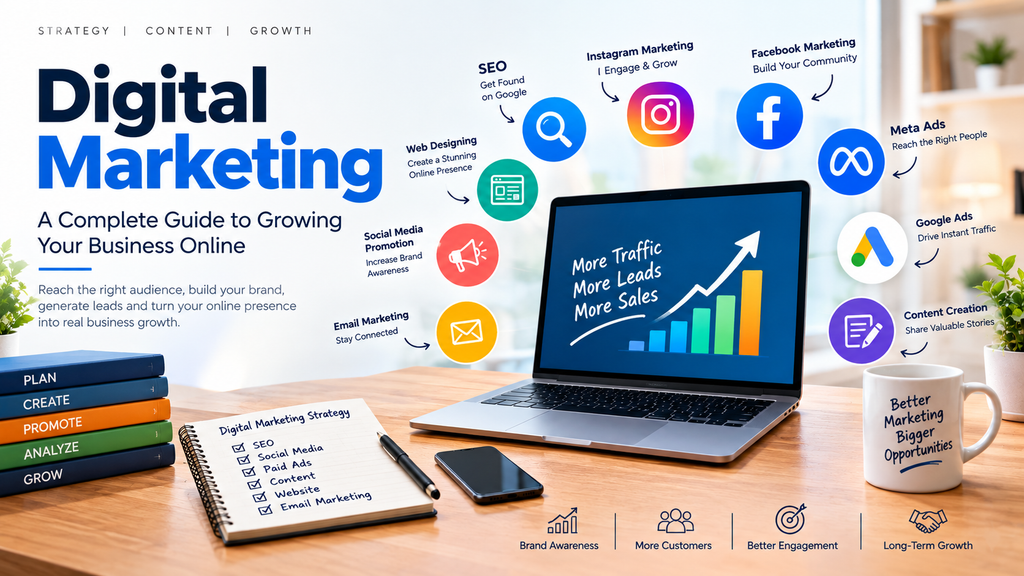
Guide to Growing Your Business Online is a practical resource for businesses that want to build a strong online presence, attract more customers, and achieve sustainable growth through digital marketing
Why Is Digital Marketing Important for Businesses?
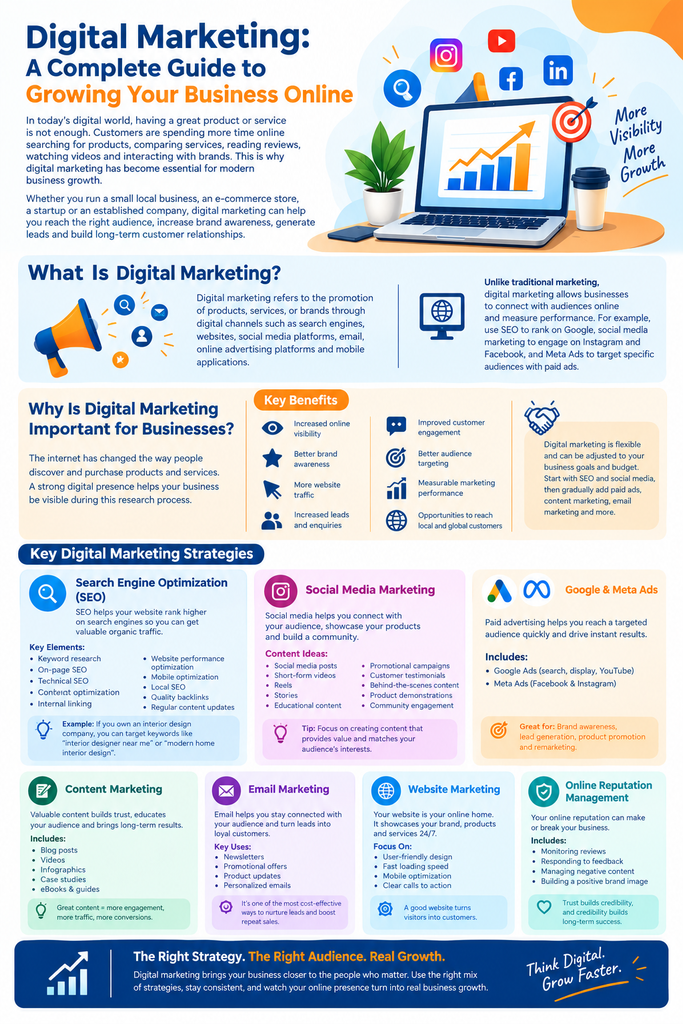
In today’s digital world, having a great product or service is not enough to grow a business. Customers are spending more time online searching for products, comparing services, reading reviews, watching videos, and interacting with brands. This is why digital marketing has become an essential part of modern business growth.
Whether you run a small local business, an e-commerce store, a startup, or an established company, digital marketing can help you reach the right audience, increase brand awareness, generate leads, and build long-term customer relationships.
Digital marketing includes several online marketing techniques such as SEO, social media marketing, Google Ads, Meta Ads, content marketing, email marketing, website marketing, and online reputation management. When these strategies work together, businesses can create a strong online presence and reach potential customers at different stages of their buying journey.
What Is Digital Marketing?
Digital marketing refers to the promotion of products, services, or brands through digital channels such as search engines, websites, social media platforms, email, online advertising platforms, and mobile applications.
Unlike traditional marketing methods such as newspapers, television, radio, and printed advertisements, digital marketing allows businesses to connect with audiences online and measure many aspects of their marketing performance.
For example, a business can use search engine optimization (SEO) to appear in Google search results, social media marketing to engage customers on Instagram and Facebook, and Meta Ads to target specific audiences with paid advertisements.
The main objective of digital marketing is to put your business in front of potential customers when they are looking for information, products, or services related to your business.
Why Is Digital Marketing Important for Businesses?
The internet has changed the way people discover and purchase products and services. Before visiting a store or contacting a company, many customers first search online.
A strong digital presence can help your business become visible during this research process.
Some important benefits of digital marketing include:
- Increased online visibility
- Better brand awareness
- More website traffic
- Increased leads and enquiries
- Improved customer engagement
- Better audience targeting
- Measurable marketing performance
- Opportunities to reach local and global customers
- Stronger relationships with existing customers
Digital marketing can also be flexible according to your business goals and budget. A company can start with SEO and social media marketing and gradually introduce paid advertising, content marketing, email marketing, and other strategies.
Search Engine Optimization (SEO)
Search Engine Optimization, commonly known as SEO, is one of the most important parts of digital marketing.
SEO involves optimizing a website and its content so that search engines can better understand the website and potentially display its pages in relevant search results.
When someone searches for a product or service, appearing prominently in search results can help bring valuable organic traffic to your website.
An effective SEO strategy generally includes:
- Keyword research
- On-page SEO
- Technical SEO
- Content optimization
- Internal linking
- Website performance optimization
- Mobile optimization
- Local SEO
- Quality backlinks
- Regular content updates
For example, if you own an interior design company, potential customers may search for phrases such as “interior designer near me,” “modern home interior design,” or “best interior design company.”
Creating useful pages and content around relevant search queries can help your website attract people who are already interested in your services.
SEO is generally a long-term strategy. Results can take time, but consistent optimization and high-quality content can help build sustainable organic visibility.
Social Media Marketing
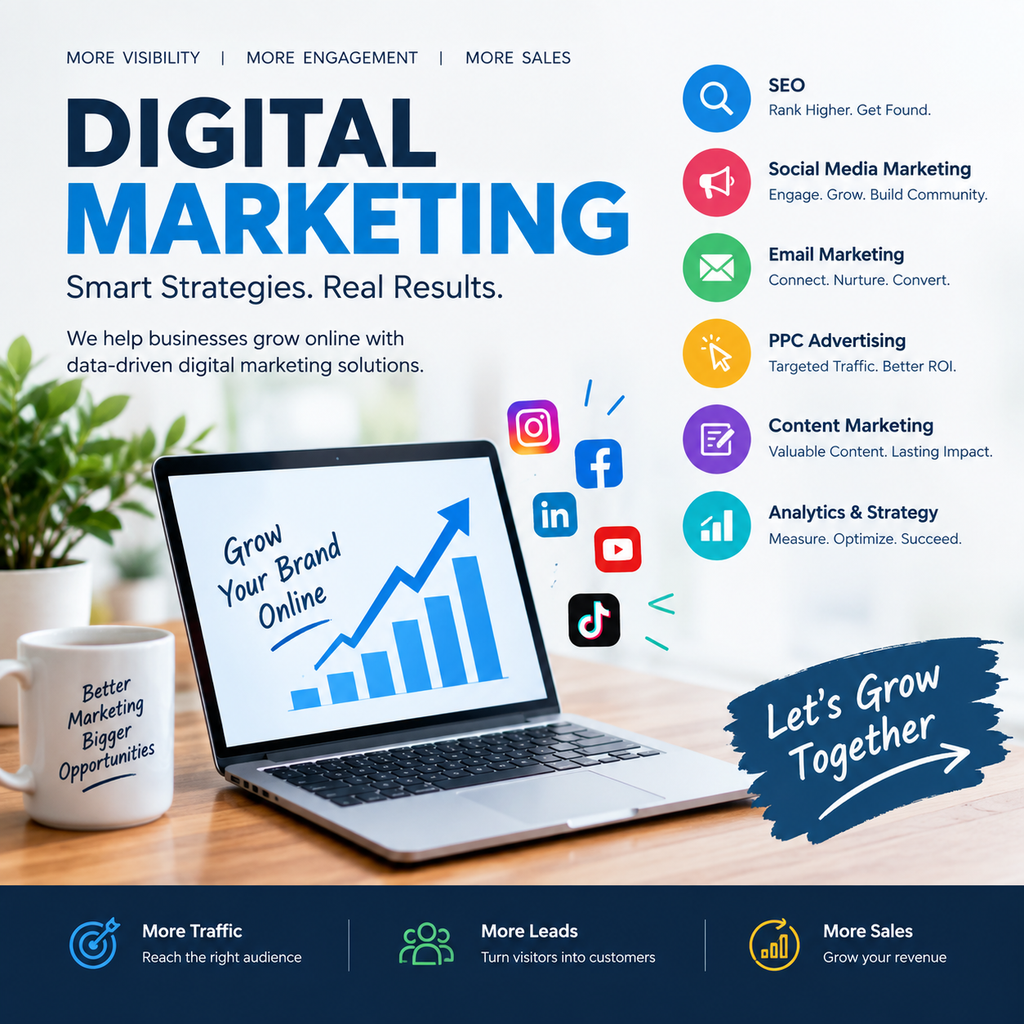
Social media has become an important communication channel between businesses and customers.
Platforms such as Instagram, Facebook, LinkedIn, YouTube, and other social networks allow businesses to showcase their products, share useful information, build communities, and communicate directly with their audiences.
Social media marketing can include:
- Social media posts
- Short-form videos
- Reels
- Stories
- Educational content
- Promotional campaigns
- Customer testimonials
- Behind-the-scenes content
- Product demonstrations
- Community engagement
The key to successful social media marketing is not simply posting frequently. Businesses should create content that provides value and matches the interests of their target audience.
For example, a restaurant can share food photography, customer reviews, special offers, and behind-the-scenes videos. An architecture company can showcase completed projects, 3D designs, floor plans, construction tips, and architectural trends.
Facebook and Instagram Marketing
Facebook and Instagram are widely used platforms for businesses looking to build awareness and generate enquiries.
Instagram is particularly useful for visually focused industries such as architecture, interior design, fashion, food, beauty, travel, real estate, and e-commerce.
Businesses can use Instagram to showcase their work through images, Reels, Stories, and educational content.
Facebook can also be useful for community building, local marketing, business updates, customer communication, and paid advertising.
A successful Facebook and Instagram marketing strategy should combine organic content with paid campaigns where appropriate.
Meta Ads
Meta Ads allow businesses to advertise across Meta platforms and target audiences using available advertising options.
One of the major advantages of paid social media advertising is the ability to create campaigns for specific marketing objectives.
For example, a business may run campaigns designed to generate:
- Website traffic
- Leads
- Messages
- Product sales
- Brand awareness
- Engagement
Businesses can also test different advertisements, audiences, creatives, and messaging to understand which combinations produce useful results.
A good Meta Ads strategy should begin with a clear objective. Instead of simply boosting random posts, businesses should create campaigns based on measurable goals and continuously analyze performance.
Google Ads and Paid Search Marketing
While social media advertising helps businesses reach audiences based on targeting options, Google Ads can help businesses reach people actively searching for particular products or services.
For example, someone searching for “digital marketing agency near me” may already have a strong interest in hiring a marketing company.
Paid search advertising can place relevant business advertisements in front of users during these high-intent searches.
A Google Ads campaign may involve:
- Keyword research
- Search campaigns
- Ad copy
- Landing pages
- Conversion tracking
- Budget management
- Performance analysis
- Campaign optimization
Businesses should monitor their advertising performance regularly rather than assuming that launching an advertisement automatically produces good results.
Content Marketing
Content marketing is one of the foundations of modern digital marketing.
It involves creating and distributing useful, relevant, and valuable content to attract and engage a target audience.
This type of content can include:
- Blog posts
- Articles
- Infographics
- Videos
- Social media posts
- Case studies
- Guides
- Tutorials
- FAQs
- E-books
For example, a web design company can publish an article about “How to Create a Professional Business Website.” A real estate company can publish “Things to Check Before Buying a Home.”
Useful content can answer customer questions while also creating opportunities to introduce your products or services.
Website Design and Digital Marketing
Your website is often one of the most important digital assets of your business.
A professional website can provide information about your services, establish credibility, showcase your work, and give customers a convenient way to contact you.
A business website should ideally be:
- Mobile-friendly
- Fast-loading
- Easy to navigate
- Visually professional
- Search-engine friendly
- Secure
- Easy to contact
- Focused on clear calls to action
Website design and SEO should also work together. A beautiful website that cannot be found through search engines may have limited organic reach, while a highly optimized website with poor user experience may struggle to convert visitors.
Local SEO for Small Businesses
For businesses serving a particular city or geographic area, local SEO can be extremely valuable.
Local SEO helps businesses improve their visibility for searches related to specific locations.
For example, a customer might search for:
“Digital marketing agency in Delhi”
“Web designer near me”
“SEO company in Panipat”
“Best interior designer in Gurgaon”
Businesses can improve local visibility by maintaining accurate business information, creating location-relevant content, optimizing their website, collecting genuine customer reviews, and maintaining their online business profiles.
Local SEO is particularly useful for restaurants, clinics, salons, real estate companies, service providers, retail stores, and local professional services.
Email Marketing
Email marketing remains a useful way to communicate with existing customers and leads.
Businesses can use email campaigns to share:
- New products
- Special offers
- Company updates
- Educational content
- Newsletters
- Product recommendations
- Event announcements
The most effective email marketing focuses on providing relevant information rather than sending excessive promotional messages.
Businesses should also obtain appropriate permission and follow applicable privacy and marketing requirements when collecting and using customer email addresses.
Importance of Analytics in Digital Marketing
One of the major advantages of digital marketing is the ability to measure performance.
Businesses can track metrics such as:
- Website visitors
- Traffic sources
- Search visibility
- Leads
- Conversions
- Engagement
- Advertising costs
- Click-through rates
- Conversion rates
- Customer acquisition costs
These insights can help businesses understand which marketing activities are generating useful results.
For example, if a company receives significant website traffic from SEO but very few enquiries, it may need to improve its landing pages, calls to action, website experience, or offer.
Marketing analytics therefore helps businesses make decisions based on data rather than assumptions.
Digital Marketing for Small Businesses
Digital marketing is not only for large companies. Small businesses can also use online marketing to compete for attention in their local or niche markets.
A small business can begin with a focused strategy instead of trying every marketing channel at once.
A basic digital marketing plan could include:
- Create a professional website.
- Research relevant keywords.
- Optimize important website pages.
- Create useful blog content.
- Maintain active social media profiles.
- Improve local SEO.
- Collect genuine customer reviews.
- Test paid advertising when appropriate.
- Track leads and conversions.
- Improve the strategy based on performance data.
The right strategy depends on the business, target audience, location, industry, competition, and available budget.
How to Create a Digital Marketing Strategy
A successful digital marketing strategy should start with clearly defined goals.
For example, your goal could be to increase website enquiries, generate leads, sell products online, increase local visibility, or improve brand awareness.
Next, identify your target audience.
Ask questions such as:
- Who are your ideal customers?
- What problems are they trying to solve?
- What products or services do they need?
- Which platforms do they use?
- What search terms might they use?
- What factors influence their buying decision?
After understanding your audience, select the marketing channels that match your goals.
For example, an e-commerce company may focus heavily on SEO, social media, content, and paid advertising, while a local service business may prioritize local SEO, Google Ads, website optimization, and customer reviews.
Common Digital Marketing Mistakes
Businesses sometimes make digital marketing mistakes that can reduce the effectiveness of their campaigns.
Common mistakes include:
- Targeting everyone instead of a specific audience
- Using irrelevant keywords
- Publishing low-quality content
- Ignoring mobile users
- Having a slow website
- Posting without a content strategy
- Running advertisements without clear objectives
- Failing to track conversions
- Expecting immediate SEO results
- Copying competitors without developing a unique brand
Avoiding these mistakes can help businesses use their marketing budget and resources more effectively.
The Future of Digital Marketing
Digital marketing continues to evolve as technology and customer behavior change.
Businesses are increasingly using artificial intelligence, automation, video content, data analytics, personalization, and new digital platforms to improve their marketing strategies.
However, the fundamentals remain important: understanding customers, creating useful content, maintaining a strong online presence, providing a good user experience, and measuring results.
Businesses that continuously learn and adapt can respond more effectively to changes in customer behavior and digital technology.
Conclusion
Digital marketing has become an essential part of business growth in the modern online economy. From SEO and social media marketing to Meta Ads, Google Ads, content marketing, website design, local SEO, and email marketing, businesses have many opportunities to connect with potential customers.
The most effective approach is not necessarily to use every available platform. Instead, businesses should identify their audience, establish clear goals, choose relevant marketing channels, create useful content, monitor performance, and continuously improve their strategy.
Whether you are launching a new business or trying to expand an established company, building a strong digital presence can help you become more visible, connect with your audience, and create opportunities for sustainable growth.
A well-planned digital marketing strategy combines creativity, technology, data, and customer understanding. With consistent effort and continuous optimization, your online presence can become an important part of your overall business strategy.
Best Blog Ever